


CSIR-CFTRI offers its expertise and facilities to industry, entrepreneurs and institutions: business development support, food analysis, pilot plant facilities and specialised research equipment.
Business Development
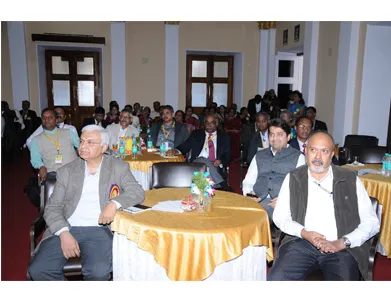
CSIR-CFTRI works with industry in several ways:
- Short projects: one-time activities of short duration, such as testing and analysis, or technical assistance of an advisory nature. This mode is especially suited to MSMEs.
- Consultancy: support for preparing a Detailed Project Report (DPR), turn-key solutions, advisory support and more.
- Technology purchase: off-the-shelf purchase of technologies developed by CSIR-CFTRI.
- Specific solutions: R&D and product development for defined objectives, as short projects of about 9–12 months.
Food Product Analysis & Quality Assurance
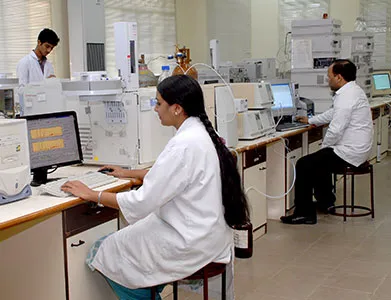
Quality of food is inextricably linked to health. Access to sufficient amounts of safe and nutritious food is the key to sustaining life and promoting good health.
The Institute provides analytical services, which include the determination of proximate composition; nutritional analysis (oils and fats, milk and milk products, sweets and confectionery); analysis of food additives (preservatives, synthetic colours, artificial sweeteners, antioxidants, etc.); analysis of food contaminants (heavy metals, pesticides, aflatoxins, antibiotics, etc.); and microbiological safety of food products.
A wide range of science-based food analytical services are offered to food and allied industries through the customer service cell, for compliance under the Food Safety and Standards Act 2006 (FSSA 2006), the Bureau of Indian Standards (BIS), AGMARK, and other national and international standards. Laboratory accreditation is a hallmark of competence and quality assurance: the facility is ISO 17025:2005 certified and accredited for more than 300 analytical parameters for chemical and biological testing of foods.
It has been designated as a Referral Food Laboratory (RFL) by FSSAI, Ministry of Health & Family Welfare, Government of India. The facility functions under the provisions of FSSA 2006 and its Rules & Regulations 2011, and contributes to the development and implementation of national food standards and regulations for regulatory and academic organisations, and for domestic food business as well as imports. The laboratory also provides consultancy in setting up quality assurance laboratories for food and agricultural commodities.
Pilot Plant Services
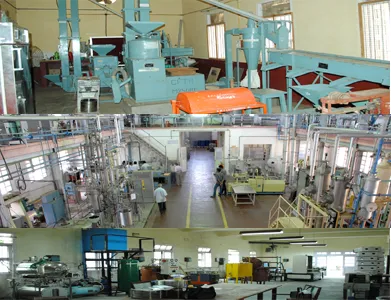
The Institute has diverse equipment and machinery for pilot production of food products, some of it developed in-house. The facility can be hired by SMEs, entrepreneurs and others for manufacturing and for introducing new or existing products on a trial basis. Its services are a boon to small and medium-scale industries and new entrepreneurs.
Major processing units housed in the facility include twin-screw extrusion equipment, a cryogenic grinding system, drying systems, roasting systems and forming machinery. There is also a Design Centre and Prototype Fabrication Units that assist with automation needs in food processing. Mini pilot plants attached to the technology departments cater to the processing of grains, spices, baked goods, fruits and vegetables, packaging and meat.
Small Animal Imaging Facility
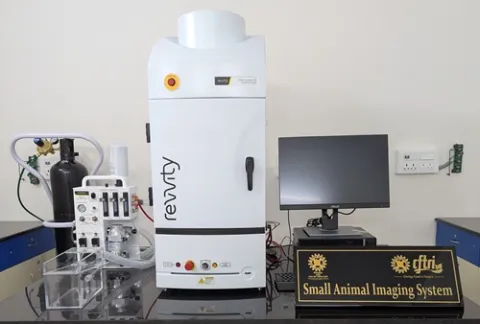
- Equipment
- IVIS Lumina X5 in vivo imaging system (make: Revvity)
- Location
- Small Animal Imaging Facility, Room 119, Department of Biochemistry, CSIR-CFTRI, Mysuru – 570 020
- Enquiries and booking
- Mr. Shinde Vijay Sukhdeo, Senior Technical Officer, svijay[dot]cftri[at]csir[dot]res[dot]in
Equipment description
IVIS Lumina X5 is a 2D optical in vivo imaging system that enables the capture of a time series of optical images following a bolus injection of a probe (radiotracer, bioluminescent or fluorescent) to monitor probe biodistribution, and X-ray imaging. Photons diffuse through tissue; using 19 excitation filters and seven emission filters that support CPS spectral unmixing, they pass through an emission filter, allowing the desired wavelength to form an image on the CCD camera. Similarly, X-ray photons from the X-ray module penetrate tissue, are typically absorbed or scattered, and scintillate on the camera. Acquisition can include up to three simultaneous imaging modes, such as X-ray, luminescent and photograph, or X-ray, fluorescent and photograph.
Applications
IVIS enables visualisation of bioluminescent, chemiluminescent and fluorescent probe biodistribution, along with X-ray imaging and precise quantification in vivo, in vitro and ex vivo. IVIS also supports dual bioluminescence and fluorescence for molecular profiling. Its high sensitivity allows IVIS to be used in studies related to diabetes, metabolism, cancer and inflammation in live animals.
Charges
| Sample type | Academic | Non-academic | Remarks |
|---|---|---|---|
| Inanimate samples (ex vivo, cell lines, plant tissue, etc.) | ₹4,000 | ₹8,000 | Excludes 18% GST |
| Live animals | ₹6,000 | ₹10,000 | Excludes 18% GST and consumables such as syringes and dyes needed for injection |
- Service request form for users (PDF, 126.72 KB)
- Book through I-STEM (Indian Science Technology and Engineering facilities Map, external website)